Point to Point Wireless Links Cisco Aironet 1500 Series Access Point can use its backhaul radio to bridge two wired segments in point to point mode. Its a mesh network with only one MAP and no WLAN clients. If Ethernet bridging is enabled, then wireless client access can be provided but is not recommended if … Continue reading CCNP Wireless CUWSS 642-732 Summary Notes 8 : Bridging Models
Tag: CCNP Wireless Summary Notes
CCNP Wireless CUWSS 642-732 Summary Notes 7 : Survey Models
Data Only Coverage Does not require a large amount of overlap due to rate shifting; generally 5 to 10 percent, with 10 - 15 % overlap between the cells Separation of access points is typically 120 to 130 feet ( 37 to 40 m) 2.4 band 802.11b/g propagates through floors. The 5-GHz waveform of 802.11a has approximately … Continue reading CCNP Wireless CUWSS 642-732 Summary Notes 7 : Survey Models
CCNP Wireless CUWSS 642-732 Summary Notes 6 : Safety and Aesthetics Considerations
Safety Considerations Ladder and Aerial Lift Safety - horizontal distance from the top support to the footoftheladder is about one-fourth of the working lengthoftheladder. Do not exceed the lift maximum load, taking into account the worker, the materials, and the tools. Self-supporting (foldout) and portable ladders that are not self-supporting (leaning) must be able to support at least … Continue reading CCNP Wireless CUWSS 642-732 Summary Notes 6 : Safety and Aesthetics Considerations
CCNP Wireless CUWSS 642-732 Summary Notes 5 : Regulatory Issues
Regulatory Domains: Several countries use the same regulatory rules, forming regulatory domains. They define such things as power of transmission, antenna gain and frequency used. A domain - US, Taiwan, Puerto Rico etc - Follow Federal Communication Commision rules E domain - Europe, Israel, Mexico, Singapore etc - follow Europe Telecommunication Standard Institute Rules Japan - follow Ministry … Continue reading CCNP Wireless CUWSS 642-732 Summary Notes 5 : Regulatory Issues
CCNP Wireless CUWSS 642-732 Summary Notes 4 : 802.11n hardware
When performing a survey for 802.11n, signal strength is not an accurate predictor of 802.11n performance. Multipath can actually enhance performance with 802.11n clients. 802.11n hardware Disadvantage of non-802.11 hardware is that they may have 2 antennas per band but they both are connected to the same radio circuit so when they receive a signal, the … Continue reading CCNP Wireless CUWSS 642-732 Summary Notes 4 : 802.11n hardware
CCNP Wireless CUWSS 642-732 Summary Notes 1 : Site Survey Requirements for Different Vertical Industries
A site survey is a task-by-task process in which the surveyor studies the facility to understand the RF behavior, discovers RF coverage areas, checks for RF interference, and determines the appropriate placement of wireless devices. Top considerations: Identify Customer Requirements and his expectations. What type of environment? Consider the regulatory issues for that particular site Asses the … Continue reading CCNP Wireless CUWSS 642-732 Summary Notes 1 : Site Survey Requirements for Different Vertical Industries
CWNA Summary Notes: Site Survey Tools
Indoor Site Surveys Tools Spectrum analyzer for RF spectrum analysis Blueprints or floor plans of the facility Received signal strength measurement tool 802.11 client card - prefer the vendor that will be deployed AP - preferably 2. Battery pack for AP and for the laptop Binoculars to view distant objects ( eg high ceiling and in … Continue reading CWNA Summary Notes: Site Survey Tools
CWNA Summary Notes: Spectrum and Coverage Analysis
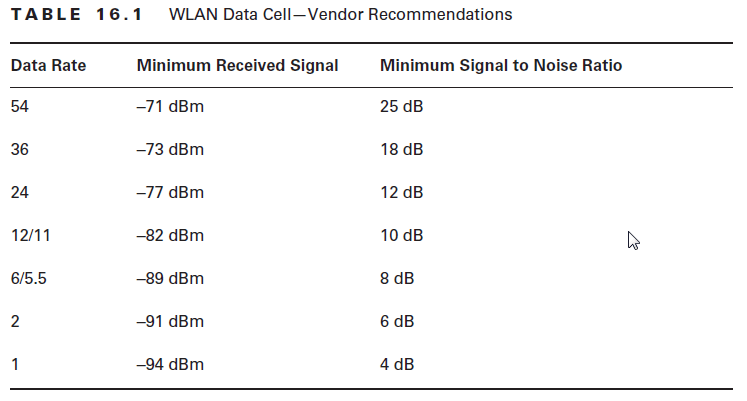
Spectrum Analysis A noisy environment can cause the data in 802.11 transmissions to become corrupted -> the cyclic redundancy check (CRC) will fail -> the receiving 802.11 radio will not send an ACK frame to the transmitting 802.11 radio -> the unicast frame is not acknowledged and will have to be re-transmitted. Wi-Fi data networks can handle a retransmission rate … Continue reading CWNA Summary Notes: Spectrum and Coverage Analysis
 CyberSecFaith